News
PVC Foam Sole Formula and Foaming Regulator Solutions
Optimizing PVC Foam Soles: Formula and Foaming Regulator Insights
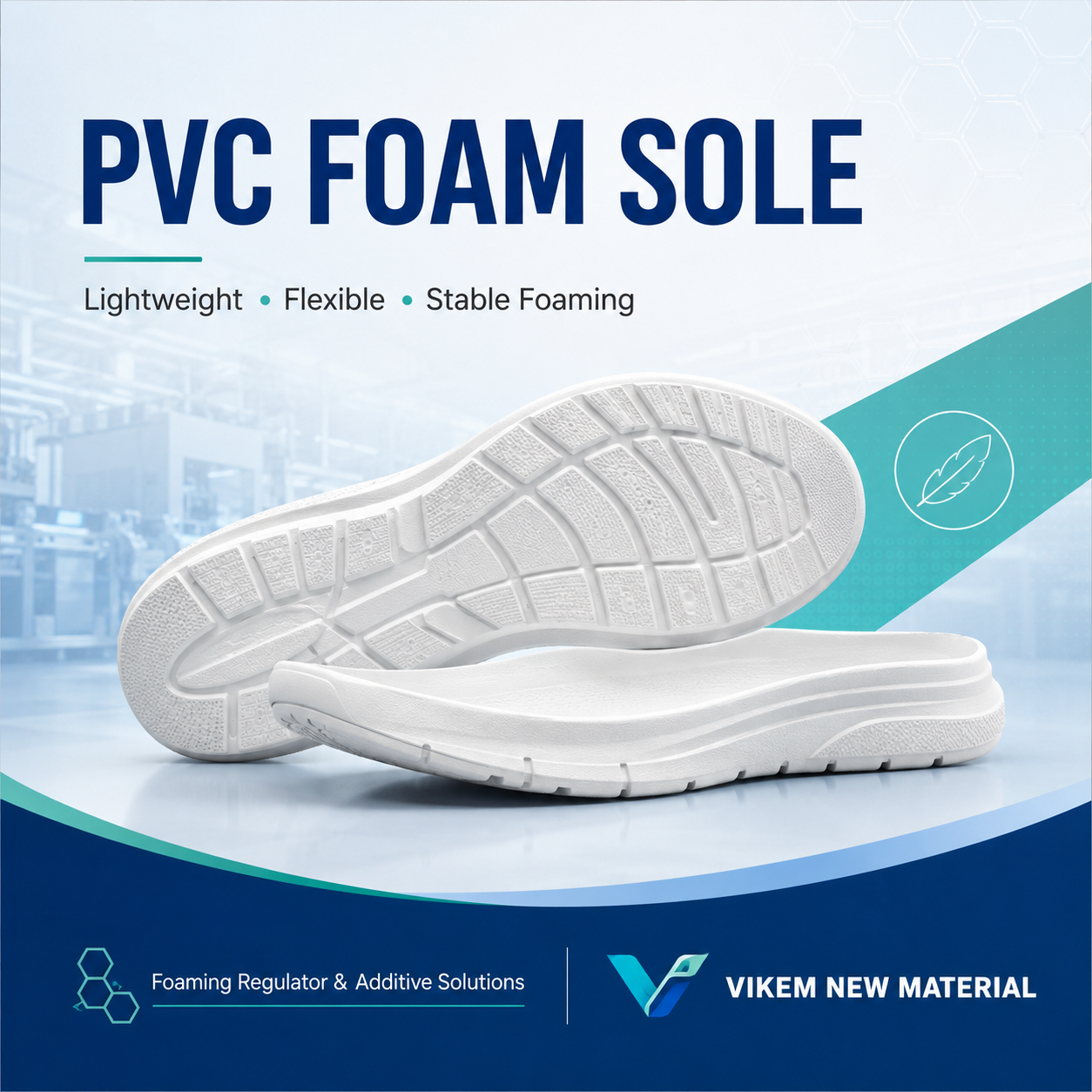
PVC foam soles are widely used in footwear due to their lightweight, cushioning, and durable properties. Achieving consistent foam structure and mechanical performance requires careful attention to both formulation and foaming process.
At VIKEM NEW MATERIAL, we emphasize three key aspects for high-quality PVC foam soles:
1. Formula Balance: The proportion of PVC resin, plasticizers, stabilizers, and lubricants must be optimized. Internal and external lubricants influence melt flow, surface smoothness, and foam uniformity. Stabilizers ensure thermal stability during extrusion and prevent yellowing or defects.
2. Foaming Regulator Selection: The choice of PVC foaming regulatorcritically affects bubble size, distribution, and melt strength. Proper regulator selection prevents collapse, uneven thickness, and poor compression resistance in the sole. VIKEM’s high-performance regulators (e.g., KRT-530) provide stable foam cell structure, improved resilience, and uniform density.
3. Process Control: Extrusion temperature, die design, and cooling rate must be fine-tuned to match the formula and regulator. Even minor adjustments can significantly reduce warping, voids, or surface imperfections.
By combining optimized formula, targeted foaming regulator, and precise process control, footwear manufacturers can produce PVC soles that are not only comfortable and durable but also consistent in quality across batches.
At VIKEM NEW MATERIAL, we partner with customers to evaluate formulations, recommend foaming regulators, and troubleshoot production challenges to achieve high-performance PVC foam soles.
RELATED NEWS
- Introduction to chlorinated polyethylene 2020-06-04
- PVC Processing Additives Selection Principle 2022-03-08
- PVC impact modifier classification 2020-03-11
- CPE vs Acrylic impact modifier for PVC pipes 2021-05-09
- Analysis of PVC foaming regulator and Regular Grades 2018-01-25
CATEGORIES
LATEST NEWS
-
PVC Foam Sole Formula and Foaming
Learn how PVC foam sole formulation, foaming age
-
Acrylic Impact Modifier for Rigid
VIKEM Acrylic Impact Modifier KRT-22, KRT-40 and
-
What is CPE135A? A Key PVC Impact
Looking for reliable CPE135A supplier? VIKEM NEW
CONTACT US
Contact:
Phone:
Tel:
Email: info@krtchem.com
Add: Economic Development Zone, Linqu County, Weifang City, Shandong Province, China